Showing posts with label Mitsubishi. Show all posts

Tuesday, 9 October 2012

2012 Mitsubishi Shogun FULL ROAD TEST


 Mitsubishi Shogun Black Edition Auto


Menacing isn't it? This is the Shogun Black Edition, Mitsubishi's latest addition to the rugged Shogun family which is based on the top spec SG4.  It comes drenched in standard equipment including a Rockford entertainment unit that has three DVD players, Dolby Surround sound and a music server. The fourth generation Shogun has been around for a rather long time now but is there still life in the old dog yet? We find out

If you’re a fan of swanky looking four-by-fours to wow your affluent friends look away now, this is a car for people who need a rugged car with genuine ability when the terrain turns ugly. Despite this the Shogun is still visually appealing for very different reasons.

It’s a design that has been slowly updated over the years in all of the key areas so despite the dated looking glass area and relatively short wheelbase the rest of the design is bang up-to-date. At the front there is more than a hint of Range Rover and a short overhang results in a good entry/departure angles when off-road. The side profile still looks fresh enough thanks to the absolutely massive 20” alloy wheels and swollen arches. At the back the spare wheel is traditionally mounted on the door-like tailgate and the clear rear lights look good.

The Black Edition we are testing here cranks up the look further with satin black everywhere including the front grill, mirrors, roof, door handles and those wheels. For those who find it all a little too dark can specify other colours including white, metallic silver, red and brown.

The interior is a really rather nice place to spend time, we especially liked the commanding driving position making it easy to peer over everything else on the road. The design itself is as you would expect; durable, well designed and good to look at. Everything is nicely laid out and operates with precision. It’s also pleasing that a lot of the materials are soft touch and the dials wouldn't look out of place in any other Mitsubishi and are dead easy to read. The only let-down is the brittle feeling multi-function computer on the centre console with its large pixel display and flimsy trim around the ancient-looking heated seat switches.


Cabin space is generous all-round with acres of rear leg, head and shoulder room. In the cavernous boot there are an additional pair of seats that pivot from under the floor, these also benefit from decent space for younger passengers. Those in the back will however find the pair of headrest-mounted multimedia screens an unexpected luxury. Passengers can watch DVDs, plug in USB devices, play games or even listen to different radio stations. They also come with wireless headphones to avoid annoying mum and dad in the front or coupled with the dash-mounted head-unit all passengers can watch the same movie in Dolby 5.1 Surround sound which incorporates a boot mounted Sub-woofer.

As soon as you turn the key you know you are sitting behind a pretty beastly engine. The Shogun is fitted with Mitsubishi’s 3.2 Litre 197bhp DI-DC turbo diesel mated to a 5-speed automatic gearbox. At idle there is no hiding its more agricultural roots which make for a gruff engine note. On the move refinement improves as speeds increase and when cruising on motorways when the unit is warm everything settles down. Performance isn’t blistering but at 11.1 seconds to 62mph it also isn’t bad especially considering its 2.2 tonne kerb weight. The gearbox itself is very good keeping stray revs under control with the option of swapping cogs manually with a nudge of the gear shifter.

For a car of such epic proportions the Shogun actually drives very well. Considering the massive wheels it rides well enough over most surfaces only really getting caught out around town where it can become a little choppy. The steering is also communicative enough although it can feel a little heavy. Taking corners with excess speed would be a silly idea as the Shogun serves up plenty of body roll but it always feels safe, under control and cossets passengers with minimal wind and road noise.
It will come as no surprise that Shogun excels off-road. Although its difficult to assess the cars outright ability off the beaten track we did however give it a go on a very slippery, muddy farm track. It coped very well once the locking differential was activated for optimum traction. Despite our cars standard road tyres it was impossible to get stuck which will really appeal to those who live in more rural areas.

Words and Photos by Rob McSorley


Price as tested: £41,999

Engine: 3.2 litre 16v 197bhp - 0-62mph: 11.1secs - Maximum Speed: 111mph -

Economy: 28mpg (urban) –37.7mpg (extra-urban), 33.2mpg (combined) - Emissions: 224g/km (Band K) - VED (12 months): £600

Dimensions: Length: 1430mm - Width: 1395mm - Height: 1110mm - Wheelbase: 2780mm

*data from Mitsubishi UK

The Verdict


At just under £42,000 you could be fooled into thinking that the Black Edition is expensive but when you consider the standard fit goodies on-board such as Sat nav, Reversing camera, iPod connection, Cruise control, Electric windows, Heated leather seats, and Auto lights and wipers it begins to make a better case for itself. Spec a Land Rover Discovery to the same level and you will be looking at an astonishing £55,000. Owners will however need deep pockets to run the Shogun as even when driven carefully we only managed to return 24mpg but the big fuel tank prevented too many fill-ups. Emissions are class leading putting the big Mitsubishi into Band K resulting in £600 for the first year and £260 thereafter. If you are looking for a no-nonsense, rugged off-roader unstoppable in any weather condition then the Shogun is definitely worth a look. Whilst with us we found it comfortable, refined on motorways and perfect for carrying heavy loads including the whole family. Mitsubishi are also  renowned for their bomb-proof reliability and the Shogun is perhaps the best example of this.


You will like;
-Off-road ability
-Bulletproof reliability
-Cabin space
-Rugged looks
-Standard fit equipment
You won’t like;
-Gruff engine
-Dated in places

All photographs and text are the exclusive property of Rob McSorley (except where stated otherwise). They are made available for your personal viewing enjoyment only. No images are within the Public Domain. The photographs may not be copied, reproduced, redistributed, manipulated, projected, used or altered in any way without the prior permission of Rob Mcsorley (info@robmcsorleyoncars.com).

Wednesday, 25 July 2012

2012 Mitsubishi i-MiEV FULL ROAD TEST

 
We have all been hearing over the past few years that Hybrids are the way forward, we even agreed last month when we tried Peugeot’s HYbrid4 technology in the 3008. With an increasing number of clever Hybrid models cropping up is there still a place for zero calorie cars such a Mitsubishi’s i-MiEV?

I was nervous at the prospect of trying an all-electric car which was pretty irrational really. It’s just comforting to know that under the bonnet you have a conventional petrol or diesel engine that makes all the right noises and can be quickly refuelled at my local service station. But still I dealt with the fear to find out what the i-MiEV has to offer.

What is it?

library image
The I-MiEV is a full electric version Mitsubishi’s i city car – or Kei car as they are known Japan – that was launched in the UK in early 2010. It was the UK’s first mass produced full Electric Vehicle (EV). When compared to European city car rivals the i-MiEV’s design is very different as it is rear wheel drive with its batteries concealed neatly under the rear seats. Even the petrol variant (simply called i) has its small 659cc petrol engine in the same location. This enabled Mitsubishi to create a cab-forward, wheel-at-each-corner design with next-to-no front overhang meaning surprisingly good passenger space. Powering the tiny i-MiEV is a 49kw permanent magnet synchronous motor producing 188Nm of torque with a claimed maximum range of 93 miles.  Power is delivered through a one-speed fixed gear CVT transmission with on-board regenerative braking system. There is only one version on sale which costs £28,990 which with the governments “plug-in grant” allowance brings the consumer price down to £23,990. Standard equipment includes leather seats, Kenwood touchscreen navigation/dvd/cd/Bluetooth media system, reversing camera, air conditioning, automatic lights, LED rear lights and alloy wheels. Safety kit includes 6 airbags, ABS with EBD and Brake Assist, Traction Control and Mitsubishi Active Stability Control (ASC) 

Rivals: Nissan Leaf, Peugeot 107, Volkswagen UP!

Key Features

  • Heated leather seats
  • 15” alloy wheels
  • Automatic lights
  • Electric front and rear windows
  • Kenwood navigation/dvd/cd/media system
  • ABS, EBD and Brake Assist
  • Reversing Camera
  • Air conditioning
  • 90 mile range (claimed)


Looking at images in magazines is one thing but seeing the i-MiEV in person is quite different, when I first clapped eyes on it I was pleasantly surprised. Here was a diddy little car with some really rather strange proportions, it has no front overhand or bonnet  as such, more of a Smart ForTwo front end. The wheels are pushed as far out to the corners of the car as possible with an a-pillar that sweeps seamlessly back towards the rear of the car where a pair of clear light units sit either side of the rear window. Attractive 15” alloy wheels avoid looking too small but what’s most strange is the width of the i-MiEV; or lack of it – at only 1475mm wide compared to its height at 1610mm its one of the most uniquely proportioned cars on the road. We would however leave the garish body stickers on the options list.

Unique profile couldn't be mistaken for anything else on the road
Narrow body can clearly be seen at the rear but clear tail-lights an neat spoiler look good

Inside is a bit of a surprise to those of a nervous disposition as our test car came with bright red leather not only on the seats but also on the centre console and gear shifter with matching red stitching. Some will undoubtedly appreciate the brash interior but we were not keen.  

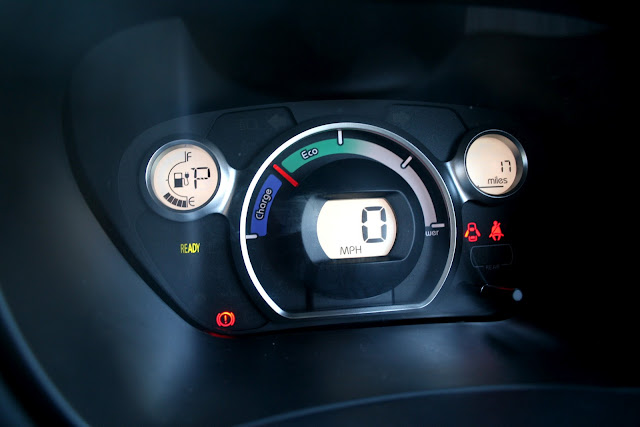
Everything else about the interior is relatively inoffensive; all of the major controls are where you would expect to find them, with the exception of the heated seats switch which for some reason is located under the dashboard. The i-MiEV does without traditional dials and instead has a simple power gauge which usefully shows when the cars regenerative braking system is charging its own batteries. There is also an electric meter in place of a fuel gauge and a separate gauge showing remaining range. Its simplicity is to be admired.

Sadly the i-MiEV has been left behind the times when it comes to interior build quality especially compared to recent Mitsubishis. Although covering the dashboard in leather may look upmarket unfortunately our test cars had come unstuck so was rippled and looked tatty, also the red leather covered trim section around the navigation system and heater controls came off in our hands. Although on delivery we were made aware of the problems with the leather it still isn’t very encouraging of a car with a list price of over £20,000. Furthermore everything else in the cabin is made of cheap flimsy feeling plastic that doesn’t give a solid impression which is a real shame.

Colour scheme won't be to everyone's taste, its certainly different.

Gauges couldn't be simpler and work well


Rear accommodation is generous and comfortable seats can be individually reclined
What the i-MiEV does do very well is accommodate four lanky adults in relative comfort. Rear leg and headroom is generous due to that lengthy wheelbase and space in the front is equally good. We were however quite surprised that the steering wheel lacked any adjustment but the driver’s seat could be raised or lowered making a comfortable driving position easy to find. Visibility was also really good making it easy to judge the ends of the car. Boot space was another plus at a competitive 235 litres with the seats up despite the hefty electric motor sitting under the boot floor.

To drive the i-MiEV is quite different from a combustion engine car. The complete lack of noise from the powertrain bar a very faint whir takes some getting used to but not as much as the instant power.  At first it’s a little startling as- unlike conventional engines- electric motors produce their maximum torque – in this case 180Nm – from standstill making for outstanding performance. Acceleration is also seamless as the i-MiEV has no gears. Once over this the rest of the driving experience is relatively normal.

Around town the car is in its element, its narrow body and peppy performance is a real bonus making darting around easy. Comfort at these speeds is also good with a supple ride that deals with urban potholes well and a hushed cabin. Take the i-MiEV out of the city and its lack of dynamic prowess becomes evident. Faster A-roads are ok, it’s able to pick up speed nicely and is happy to cruise along at the national speed limit providing it’s not too windy. When it is the narrow tracks front and rear make the i-MiEV all too susceptible to crosswinds trying to blow it off course.

Country roads are perhaps best avoided completely as the cars tiny 145 width tyres at the front make it feel overly springy and completely lacking in stability. There is also a hair-raising lack of grip around corners causing bucket loads of understeer that the stability control fails to reign in. 

With a claimed range of 93 miles from a full charge – taking 7 hours if charging from your main electric at home- the i-MiEV could be the perfect car for the majority of daily journeys. Whilst with us the most we managed to get out of the batteries was 67 miles when driven very carefully with the gauge in Eco mode and around 50 miles when not. This means that for my daily commute of 20 or so miles per day I would need to charge the car every day which wouldn’t really be practical. For those who -unlike me -live in the city the range would be perfectly adequate especially as more Fast Charge points pop up around the country resulting in a 30 minute wait for batteries charged to 80%.

 It’s also worth considering that a full charge at home only costs £1-£2 dependant on electric tariff which means over 12,000 miles the cost would only be £270; a massive saving over petrol-powered cars, add in road tax and congestion charge exemption along with free parking in a number of locations and the steep asking price starts to look more attractive.

Words and Photos by Rob McSorley
Technical Data 

Price as tested: £28,990 (£23,990 including government contribution)
Engine: 49kw (66bhp) permanent magnet synchronous motor - 0-62mph: 13 secs - Maximum Speed: 87 mph -
Economy: 93 mile range (claimed) - Emissions: 0g/km (Band A) - VED (12 months): £0
Dimensions: Length: 3475mm - Width: 1475mm - Height: 1610mm - Wheelbase: 2550mm

The Verdict 3/5


The Mitsubishi i-MiEV is a thoroughly though-provoking ownership proposition offering city dwellers a real alternative to conventional petrol engined cars with its low running costs. It’s a spacious car with plenty of room for four adults and decent luggage space. Add in peppy performance and good levels of comfort around town and its case becomes even stronger. Unfortunately there are a handful of glaring weaknesses that the i-MiEV has. Its limited range and extortionate asking price will be a turn-off for many. As will its lack of ability to deal with a variety of driving environments such as country roads that other city cars do so well. Whether the tiny running costs can offset the high asking price is a real talking point however you have to admire Mitsubishi’s bold move launching the i-MiEV and there is no doubt that it will - and probably already has- paved the way for a whole new generation of EVs.

You will like
Funky looks
Cabin Space
Silent, swift performance
Tiny running costs

You won’t like
Lack of dynamic ability
High price
Poorly built cabin


Special Thanks to; Mitsubishi Motors, Watermoor, Cirencester, GL7 1LF


All photographs and text are the exclusive property of Rob McSorley (except where stated otherwise). They are made available for your personal viewing enjoyment only. No images are within the Public Domain. The photographs may not be copied, reproduced, redistributed, manipulated, projected, used or altered in any way without the prior permission of Rob Mcsorley (mrrobertmcsorley@gmail.com).

Thursday, 7 June 2012

2012 Mitsubishi ASX FULL ROAD TEST


Air conditioners, escalators, optical telescopes and hand dryers are all products that you probably didn’t know Mitsubishi produce. You probably did know that Mitsubishi and 4x4s go together like itchy and scratchy or cheese and crackers.

It all started with the Shogun back in 1982 which carved a healthy share of the market rivalling the Nissan Patrol, Toyota Land Cruiser and later the Land Rover Discovery. Over the last decade as fuel prices have skyrocketed and the cost of road tax has climbed, demand for heavy 4x4s has tailed off as buyers seek out lower running costs. As a result the compact crossover was born and every manufacturer wants a piece of the pie.

Since its launch in 2007 Nissan has shifted over 1 million examples of its Qashqai which kicked off the compact crossovers journey to world domination. Mitsubishi have enjoyed considerable success in the UK with the launch of their Outlander crossover back in 2004, the latest version is even available in a more frugal 2 wheel drive guise for those who love the idea of a 4x4 buy not the dent in their wallets.

The ASX, or “Active Sports Crossover” is Mitsubishi’s attempt at repeating its big brothers success but in a smaller package aimed squarely at not only established crossovers but also traditional C-segment vehicles. We hit the road to find out if the ASX is any good and whether it can crush the opposition.

Thursday, 12 April 2012

MITSUBISHI REVIEWS COMING SOON

Rob McSorley on CARS will soon be reviewing Mitsubishi models with the cooperation of Mitsubishi Press UK

Related Posts Plugin for WordPress, Blogger...